Main Menu



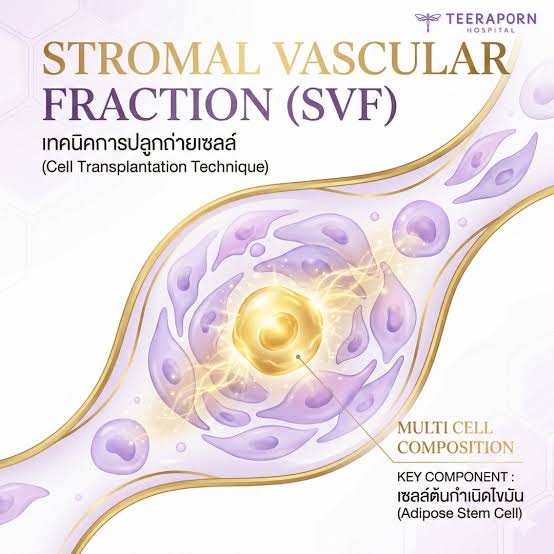
What if one of the most promising tools in regenerative medicine was already inside your body?
That is the idea behind SVF therapy. Stromal vascular fraction (SVF) is a concentrated mixture of regenerative cells drawn from a person’s own fat tissue. Researchers and clinicians are actively studying it as a way to support the body’s natural repair processes, and interest has grown rapidly over the past decade.
What Is Stromal Vascular Fraction (SVF)?
Your fat tissue does far more than store energy. It is also a rich reservoir of cells with regenerative potential. SVF is the portion of adipose tissue that remains after the fat cells themselves are removed.
What is left is a diverse blend of cell types, including:
- Adipose-derived stem cells (ADSCs) — cells capable of developing into different tissue types
- Endothelial cells and pericytes — involved in building and supporting blood vessels
- Immune cells such as macrophages and T cells
- Growth factors and signaling molecules that help coordinate healing
This combination is what makes SVF therapy interesting to regenerative medicine. Rather than a single cell type, it is a team of cells that may work together to reduce inflammation, encourage new blood vessel growth, and support tissue repair.
How Does SVF Therapy Work?
SVF therapy is typically an autologous procedure, meaning the cells come from your own body, which lowers the risk of immune rejection. A typical process looks like this:
- Harvesting: A small amount of fat is collected through a minimally invasive liposuction procedure, usually from the abdomen or flank.
- Processing: Clinicians process the harvested fat and separate the stromal vascular fraction from mature fat cells..
- Administration: Clinicians inject the concentrated SVF into the targeted treatment area.
In all cases, doctors complete the harvesting, processing, and treatment during a single visit.
How SVF May Support Healing — What the Science Says
The therapeutic interest in SVF therapy comes from three main properties observed in research:
- Angiogenesis: Supporting the formation of new blood vessels, which improves circulation to healing tissue
- Immunomodulation: Helping regulate inflammation and immune response
- Tissue support: Supplying growth factors and progenitor cells that may aid repair
What Conditions Is SVF Therapy Being Studied For?
SVF has been explored in both clinical practice and ongoing research across several areas, including:
- Orthopedic and joint conditions such as knee osteoarthritis
- Soft tissue and tendon injuries
- Chronic, non-healing wounds including diabetic foot ulcers
- Aesthetic and reconstructive applications such as fat grafting
- Cardiovascular and neurological conditions under active investigation
It is worth being clear: results vary by condition, and Many applications remain investigational and require further clinical research. Promising early findings are not the same as proven, approved treatments.
Is SVF Therapy Safe?
For most people, the biggest safety advantage of SVF is that it uses your own cells, which minimizes the risk of allergic reaction or rejection. Reported side effects are usually mild and temporary, such as:
- Swelling, bruising, or discomfort at the fat-harvest site
- Soreness at the injection site
As with any medical procedure, more serious complications are possible, particularly when SVF is administered in non-standard ways. This is exactly why the setting and provider matter so much.
Frequently Asked Questions
Is SVF the same as stem cell therapy?
Not exactly. SVF contains stem cells (adipose-derived stem cells), but it is a broader mixture that also includes other regenerative cells, immune cells, and growth factors.
Where does SVF come from?
Doctors obtain SVF from your own fat tissue, usually from the abdomen., most commonly from the abdomen.
How long does the procedure take?
In many point-of-care settings, harvesting, processing, and administration can occur in a single visit, often within a few hours.
Is there downtime?
Recovery is usually short, with mild swelling or bruising at the harvest and injection sites.
Is SVF therapy FDA-approved?
SVF is regulated by the FDA as a drug/biologic. Many uses are investigational or offered through clinical trials. Always ask a provider about the regulatory status of a specific treatment.
- References
- SVF: interprocedural static value-flow analysis in LLVM | Proceedings of the 25th International Conference on Compiler Construction
- The Use of Adipose-Derived Stem Cells (ADSCs) and Stromal Vascular Fraction (SVF) in Skin Scar Treatment—A Systematic Review of Clinical Studies
- Milligraft_Ksa
Book Your Consultation Today (http://www.instagram.com/milligraft_ksa)